
Hotel in Burlington, United States
Blind Tiger Burlington
625ptsResidential-Model Hospitality

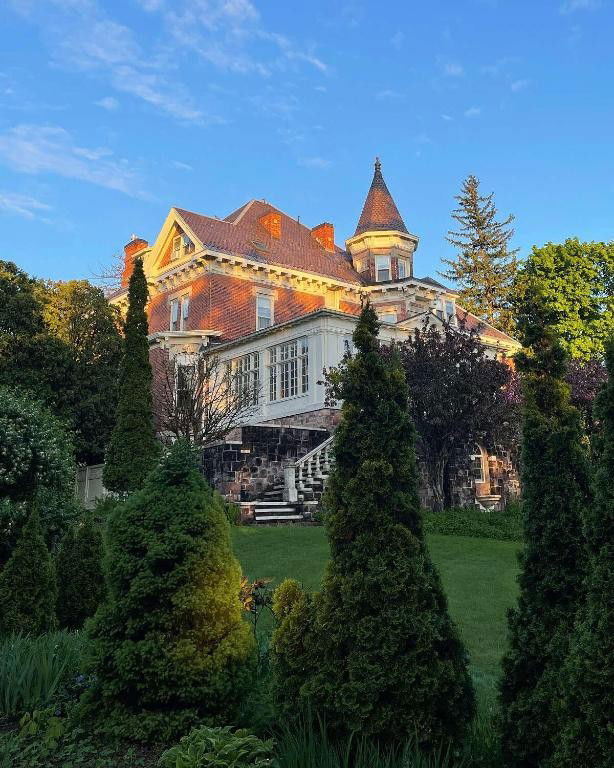
About Blind Tiger Burlington
A restored late-19th-century home on Burlington's South Willard Street, Blind Tiger Burlington operates under Lark Hotels' residential guest house model: 14 individually designed rooms, period architecture, original artworks, and the kind of host knowledge that most hotels can't replicate. Michelin awarded it a Key in 2024, placing it in a small tier of Vermont properties where design and local immersion carry more weight than amenity count.
A House That Reads the Room
South Willard Street, a tree-lined residential block close to the University of Vermont campus, is not where most travelers expect to find a Michelin-recognised property. No porte-cochere, no lobby signage competing for attention. The late-19th-century house at number 349 presents itself as what it has always been: a private home, with lawns and gardens creating a soft boundary between the street and the front door. That deliberate restraint is not an accident of budget; it is the operating premise of the Blind Tiger concept, and Burlington's version executes it with notable fidelity to the form.
Lark Hotels, the Northeastern boutique operator behind the Blind Tiger banner, has built a regional reputation around properties that prioritise architectural character over programmatic amenity. The Blind Tiger sub-brand takes that philosophy to its residential extreme: small-scale, house-format hotels where the design vocabulary comes from the building's own history rather than from a brand standards manual. Comparable residential-model boutique properties elsewhere in New England, such as Troutbeck in Amenia, share a similar instinct, though each arrives at it through different architectural inheritance.
What the Restoration Kept
The building's late-Victorian bones are the design's primary material. Fourteen rooms across the house are individually configured, shaped by the floor plan of a domestic property rather than by any standardised room-type grid. Period architectural details — the proportions of windows, the movement between rooms, the logic of a house built for habitation rather than hospitality — remain legible throughout. No two rooms carry the same footprint or orientation, which is partly constraint and partly editorial argument: that variety in a small hotel is preferable to the predictability of matched suites.
Vintage objects and original contemporary artworks sit alongside the period architecture without pretending to be period themselves. This is a different proposition from pure historic preservation, and a more interesting one. The solarium, with marble floors and a density of plant life that gives it a conservatory quality, functions as the kind of gathering space that makes a small hotel feel inhabited rather than managed. The barroom and the adjacent living room, centred on a fireplace, complete the ground-floor social circuit. At properties operating at this scale, these shared spaces do disproportionate work: they are where a 14-room hotel earns its character.
Among the broader peer set of design-led American boutique hotels, the Blind Tiger Burlington approach is closest to properties that treat the building's history as load-bearing rather than decorative. That places it in a different conversation from, say, Aman New York, where contemporary intervention is the point, or The Fifth Avenue Hotel in New York City, where a landmark address anchors the identity. Here, the address is deliberately quiet and the architecture does its work without institutional context to lean on.
The Michelin Key and What It Signals
Michelin's 2024 Key designation , the guide's hotel-specific recognition, distinct from its restaurant stars , places Blind Tiger Burlington in a tier of American properties judged on design quality, character, and guest experience rather than on room count or spa footage. For a 14-room property at $265 per night, the designation functions less as a luxury credential and more as a curatorial one: it tells a particular reader that the editors found something worth endorsing here, and that something is not scale.
The Key aligns Blind Tiger Burlington with a cohort that includes properties of very different sizes and price points, from small inn formats to larger design hotels. What they share is a Michelin assessment that the experience of staying is coherent and considered. At this price point in the Northeast boutique market, that distinction matters. It positions the property above generic B&B territory without placing it in competition with full-service luxury hotels like Raffles Boston or Four Seasons at The Surf Club. It occupies a specific niche: architectural character at an accessible price, with Michelin confirmation that the execution meets a standard.
No Restaurant, Which Is the Point
The absence of an in-house restaurant is not a gap in the offering; it is the residential model's defining feature. Breakfast is available on site. For lunch and dinner, the hotel directs guests toward Burlington's dining scene, supported by letters from local residents in each room offering personalised itinerary suggestions. That last detail is worth examining: it shifts the hotel's role from comprehensive service provider to informed local intermediary, and it is harder to execute credibly than it appears. Host knowledge of this kind, when it works, is a more durable differentiator than any amenity list.
Burlington's dining options reward that kind of guided exploration. The city's compact downtown, close to the hotel on South Willard Street, has a food and drink culture that punches above its population size, shaped in part by the university presence and in part by Vermont's broader farm-to-table identity. The hotel's position, walkable to both the university campus and the Church Street commercial district and the lakeside waterfront, keeps the logistics of restaurant-hunting direct. More detailed coverage of where to eat and drink in the city is available in our full Burlington restaurants guide.
Planning a Stay
Blind Tiger Burlington's 14 rooms are priced from $265 per night, and the property's Google rating of 4.7 across 249 reviews suggests consistent execution of its modest but specific promise. The residential neighbourhood setting means arrival and departure feel more like visiting a house than checking into a hotel, which is either a feature or a friction point depending on what the traveller is optimising for. Guests who find that framing appealing will find the property delivers on it; those expecting a traditional hotel experience would be better matched to full-service properties elsewhere in the Northeast such as Chicago Athletic Association or, further afield, Hotel Bel-Air in Los Angeles.
Burlington is most visited in foliage season, which concentrates demand in late September and October. Summer, when the lakefront and Church Street are at their most active, is the secondary peak. The property's seasonal context is worth factoring into booking timing, particularly for a 14-room house where availability narrows quickly when demand rises. Lark Hotels operates additional Blind Tiger properties across the Northeast, offering comparable residential-format options for travellers building multi-stop itineraries through the region.
How It Compares
The residential boutique category in the American Northeast has expanded considerably over the past decade, with operators including Lark and various independent owners converting historic homes into small-scale hotels. What distinguishes the better properties in that cohort is design discipline: the difference between a restored house with a coherent aesthetic argument and a renovated building with a collection of appealing objects. Blind Tiger Burlington, based on its Michelin recognition and its 4.7 Google score across a meaningful review base, appears to land in the former group.
Against properties at similar or adjacent price points in the broader boutique landscape, the Burlington house offers something that larger operations, from Amangiri in Canyon Point to Blackberry Farm in Walland, cannot replicate at their scale: the texture of staying in a specific house on a specific street, in a city where the hotel's staff and letters from local residents are the primary navigation tool. That is a narrow proposition, and it is exactly the right one for this building.
Frequently Asked Questions
Is Blind Tiger Burlington more low-key or high-energy?
Decidedly low-key, and deliberately so. The property sits in a residential neighbourhood on South Willard Street, with no restaurant, no bar programme scaled for non-guests, and public spaces designed around gathering by a fireplace rather than event-mode socialising. The Michelin Key and the $265 price point both signal a considered, quiet experience. Guests looking for an animated hotel scene would be better matched to a property with more programmatic infrastructure.
What room should I choose at Blind Tiger Burlington?
All 14 rooms are individually configured, shaped by the domestic floor plan of the original late-19th-century house, which means the selection is genuinely varied rather than a choice between nominal categories. Michelin's recognition and the property's design ethos both point toward rooms that leading express the period architectural character, where original details and vintage objects work with rather than against the contemporary artworks. The most useful approach is to contact the property directly and describe what you are optimising for: floor, light, or proximity to the shared spaces.
What's the standout thing about Blind Tiger Burlington?
The Michelin Key awarded in 2024 is the clearest external signal of what makes the property worth attention: not amenity scope, but the coherence of the design and the quality of the experience at 14 rooms and $265 per night. In practical terms, that coherence shows up most concretely in the shared spaces, the individual room character, and the host-mediated approach to navigating Burlington, where a letter from a local resident in each room does more useful work than a generic concierge list.
Recognized By

Related editorial
- Best Fine Dining Restaurants in ParisFrom three-Michelin-star icons to the next generation of Parisian chefs pushing boundaries, these are the restaurants that define fine dining in the world's culinary capital.
- Best Luxury Hotels in RomeFrom rooftop terraces overlooking ancient ruins to Michelin-starred hotel dining, these are the luxury hotels that make Rome unforgettable.
- Best Cocktail Bars in KyotoFrom sleek lounges to hidden speakeasies, Kyoto's cocktail scene blends Japanese precision with global influence in ways you won't find anywhere else.
Save or rate Blind Tiger Burlington on Pearl
Keep this venue in your Pearl passport, rate it after you visit, and track it alongside every other place you collect.