
Bar in Sandy Springs, United States
Rumi's Kitchen
100ptsDiaspora Persian, Suburban Format
About Rumi's Kitchen
Rumi's Kitchen on Roswell Road brings Persian cooking into the Atlanta dining conversation with a floor-team approach that connects kitchen craft to table service. The Sandy Springs address puts it within reach of both Buckhead and the northern suburbs, making it a practical destination for a cuisine that remains underrepresented in the metro area. Expect warm spice-driven plates served in a setting that reads as relaxed but considered.
Persian Dining in the Atlanta Suburbs: Where Rumi's Kitchen Sits
Sandy Springs occupies an unusual position in Atlanta's dining geography. Close enough to Buckhead to draw comparison with the city's more formal restaurant tier, but suburban enough that its dining rooms tend toward comfort over ceremony, it has become a corridor for cuisines that find the dense in-town market saturated. Persian cooking fits that pattern. It remains one of the more underrepresented Middle Eastern traditions in the broader Atlanta metro, and Roswell Road has quietly become one of the few stretches where it shows up consistently. Rumi's Kitchen, at 6112 Roswell Rd, has held that position for long enough that it reads less as a novelty and more as a fixed point in the local dining map.
For context on the surrounding area, our full Sandy Springs restaurants guide maps the corridor's dining character more broadly, from the Thai cooking at Bangkok Thyme and Colonial Kitchen and Bar Thai Restaurant to the seafood-focused program at C&S; Seafood & Oyster Bar, Sandy Springs.
The Room and What It Signals
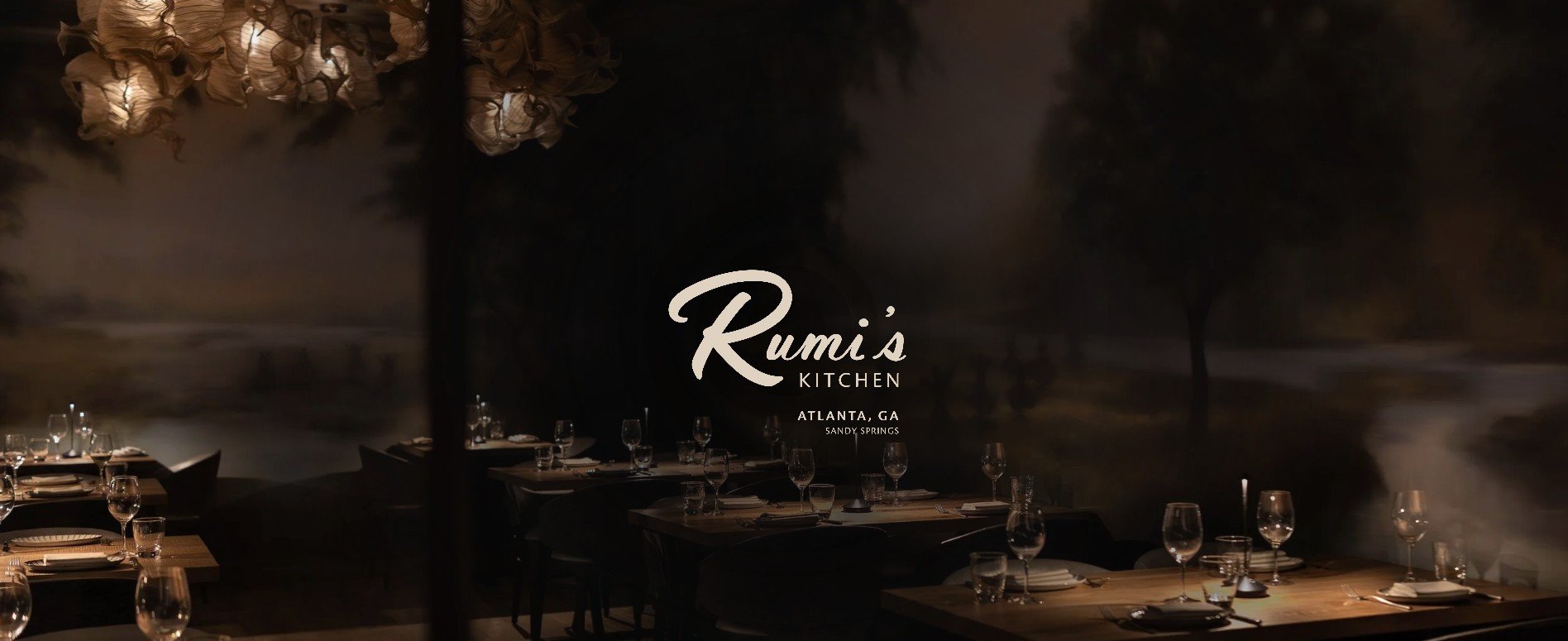
Approaching the Roswell Road frontage, Rumi's Kitchen reads like a mid-scale American restaurant from the outside, which is partly the point. Persian dining in US suburban markets has generally moved toward accessible formats rather than ethnically coded interiors, and this location follows that pattern. Inside, the atmosphere is warmer than the strip-mall context might suggest: the lighting is low enough to soften the room without obscuring the plates, and the noise level settles into the range where a table conversation at normal volume remains audible. It is the kind of room designed for a long dinner rather than a fast one, which aligns with how Persian meals tend to be structured — multiple dishes arriving in sequence rather than a single composed plate.
That pacing is worth understanding before you go. Persian cuisine is built around abundance and layering: herb-heavy salads, slow-braised meats, saffron-threaded rice dishes, and grilled proteins all tend to arrive in proximity rather than strict succession. The format suits groups more than solo diners, and the table service reflects that, with staff accustomed to managing multi-dish orders across a whole table rather than running individual plates to individual guests.
The Team Dynamic: Kitchen, Floor, and the Space Between
In restaurants where the cuisine is unfamiliar to a portion of the dining room, the front-of-house carries more interpretive weight than it does at a steakhouse or an Italian trattonic. At Rumi's Kitchen, the floor team functions as a translation layer between a kitchen working in a specific regional tradition and a guest base that may be encountering Persian cooking for the first time. That dynamic shapes how the room operates. Servers here tend to offer context on dishes rather than just recite them, which is both a hospitality choice and a practical necessity given the menu's specificity.
This kind of floor-to-kitchen collaboration is what separates a restaurant that handles a complex cuisine well from one that merely offers it. The leading examples of this in American dining — programs like Kumiko in Chicago, where the drinks program and the food program are built in deliberate conversation with each other, or Jewel of the South in New Orleans, where hospitality is explicitly framed as a studied craft , demonstrate that the floor is not auxiliary to the kitchen. At Rumi's Kitchen, the same principle applies in a more casual register: the team's ability to guide a table through an unfamiliar menu is as much a product as the food itself.
The drinks program exists in this same collaborative frame. Persian cuisine pairs less intuitively with standard American bar formats , craft cocktails built around bourbon or agave can work against the herbal and floral notes that dominate the menu. The beverage choices here are worth treating as part of the meal rather than a separate decision, and asking the floor for a pairing steer tends to yield better results than ordering off instinct. This is the kind of granular drinks intelligence that programs like ABV in San Francisco, Bar Leather Apron in Honolulu, or Superbueno in New York City have built into their identities explicitly. At Rumi's Kitchen it operates less formally, but the instinct is similar: the drink and the dish should be considered together.
What Persian Cooking Asks of a Dining Room
Persian cuisine has a longer track record in American cities with large Iranian diaspora communities , Los Angeles, the Bay Area, parts of New York and the DC metro , than it does in the Southeast. In Atlanta, the tradition is thinner, which means restaurants like Rumi's Kitchen operate without the density of comparison that a Los Angeles diner would take for granted. There is no block of Persian restaurants nearby against which to benchmark a given dish. That places more responsibility on the restaurant to be self-explaining, and on the diner to arrive with some baseline orientation.
The key markers of quality in this cuisine are not dramatic: the fragrance and even distribution of saffron in a rice dish, the tenderness of a slow-cooked lamb shank against a clean rather than muddy sauce, the balance of dried fruit and walnut in a Fesenjan-style preparation. These are not theatrical signals. They require attention to register, which is part of why the room's relaxed pace works in the cuisine's favour. A fast table turn would work against the food. The unhurried format here is a structural choice that matches the culinary tradition it serves.
How Rumi's Kitchen Compares Within Sandy Springs
Within its immediate peer set on Roswell Road, Rumi's Kitchen occupies a distinct position. Casi Cielo and the other mid-range dining options in the corridor operate in cuisines with much higher ambient familiarity among the local guest base. Persian cooking asks more of a first-time diner, and the restaurant is priced and formatted to allow for that learning curve. It is not the cheapest option on the strip, nor is it the most expensive, but it offers a cuisine with no close equivalent in the immediate neighbourhood, which is its clearest competitive differentiator.
For travellers approaching from elsewhere, the Roswell Road address places it about a fifteen-minute drive from central Buckhead, making it practical as a standalone dinner destination rather than an add-on to an in-town itinerary. Reservations are the sensible approach for weekends, when the room fills with local regulars who know the menu well enough to order without consulting the staff , a reliable indicator that the food has established a genuine following rather than a novelty audience.
Planning Your Visit
Rumi's Kitchen is at 6112 Roswell Rd, Sandy Springs, GA 30328, in the northern Atlanta metro. The format suits groups of three or more who can spread across multiple dishes; solo visits or couples work leading at off-peak hours when the room is quieter and the floor team has more time to walk a table through the menu. Dress is informal. No website or phone contact is currently listed in the EP Club database, so booking via third-party reservation platforms is the practical route. Go with an appetite for volume rather than precision: this is a cuisine of generous portions and multiple plates, not a tasting-menu format where you calibrate your hunger against a set number of courses. Arriving hungry is correct. Arriving in a hurry is not.
For broader cocktail and bar context in cities where drinks programs are built with the same collaborative rigor, Julep in Houston and The Parlour in Frankfurt on the Main offer useful reference points for what intentional pairing culture looks like at a higher tier of execution.
Frequently Asked Questions
What kind of setting is Rumi's Kitchen?
Rumi's Kitchen operates as a relaxed, mid-scale Persian restaurant on Roswell Road in Sandy Springs, GA. The room is designed for longer, multi-dish dinners rather than quick meals, with warm lighting and a noise level that stays manageable for table conversation. It sits outside the formal dining tier found closer to central Atlanta, but above the fast-casual bracket on the same corridor.
What's the must-try cocktail at Rumi's Kitchen?
Persian cuisine's herbal and floral notes pair leading with drinks that complement rather than compete with those flavors, so leaning on the floor team for a recommendation is the more reliable approach than ordering independently. The beverage program here is better treated as part of the overall table decision rather than a separate bar order. No specific cocktail details are currently verified in the EP Club database.
What should I know about Rumi's Kitchen before I go?
Persian dining is built around shared plates and generous portions, so arriving with a group and an appetite for multiple dishes produces the leading result. The address at 6112 Roswell Rd, Sandy Springs, GA 30328 is roughly fifteen minutes from central Buckhead. No price range or formal awards are currently listed in the EP Club database, but the restaurant's established local following suggests it has found its pricing level within the Sandy Springs mid-range tier. Booking ahead for weekends is advisable.
Is Rumi's Kitchen a good option for someone new to Persian cuisine?
Rumi's Kitchen is positioned on Roswell Road in a market where Persian dining has limited competition, which means the floor staff tends to carry more explanatory function than at restaurants in cities with larger Iranian diaspora dining scenes. For a first encounter with the cuisine, that guidance is an asset: the team can orient a table through dishes that have no immediate American analogue. The relaxed pacing of the room also helps, since Persian meals benefit from time at the table rather than rapid course progression.
Related editorial
- Best Fine Dining Restaurants in ParisFrom three-Michelin-star icons to the next generation of Parisian chefs pushing boundaries, these are the restaurants that define fine dining in the world's culinary capital.
- Best Luxury Hotels in RomeFrom rooftop terraces overlooking ancient ruins to Michelin-starred hotel dining, these are the luxury hotels that make Rome unforgettable.
- Best Cocktail Bars in KyotoFrom sleek lounges to hidden speakeasies, Kyoto's cocktail scene blends Japanese precision with global influence in ways you won't find anywhere else.
Save or rate Rumi's Kitchen on Pearl
Keep this venue in your Pearl passport, rate it after you visit, and track it alongside every other place you collect.