Acarajé da Dinha
Rio Vermelho, Salvador
Bar in Salvador, Brazil
 Book with Pearl
The Read
Barraca Orthodoxy
Why go
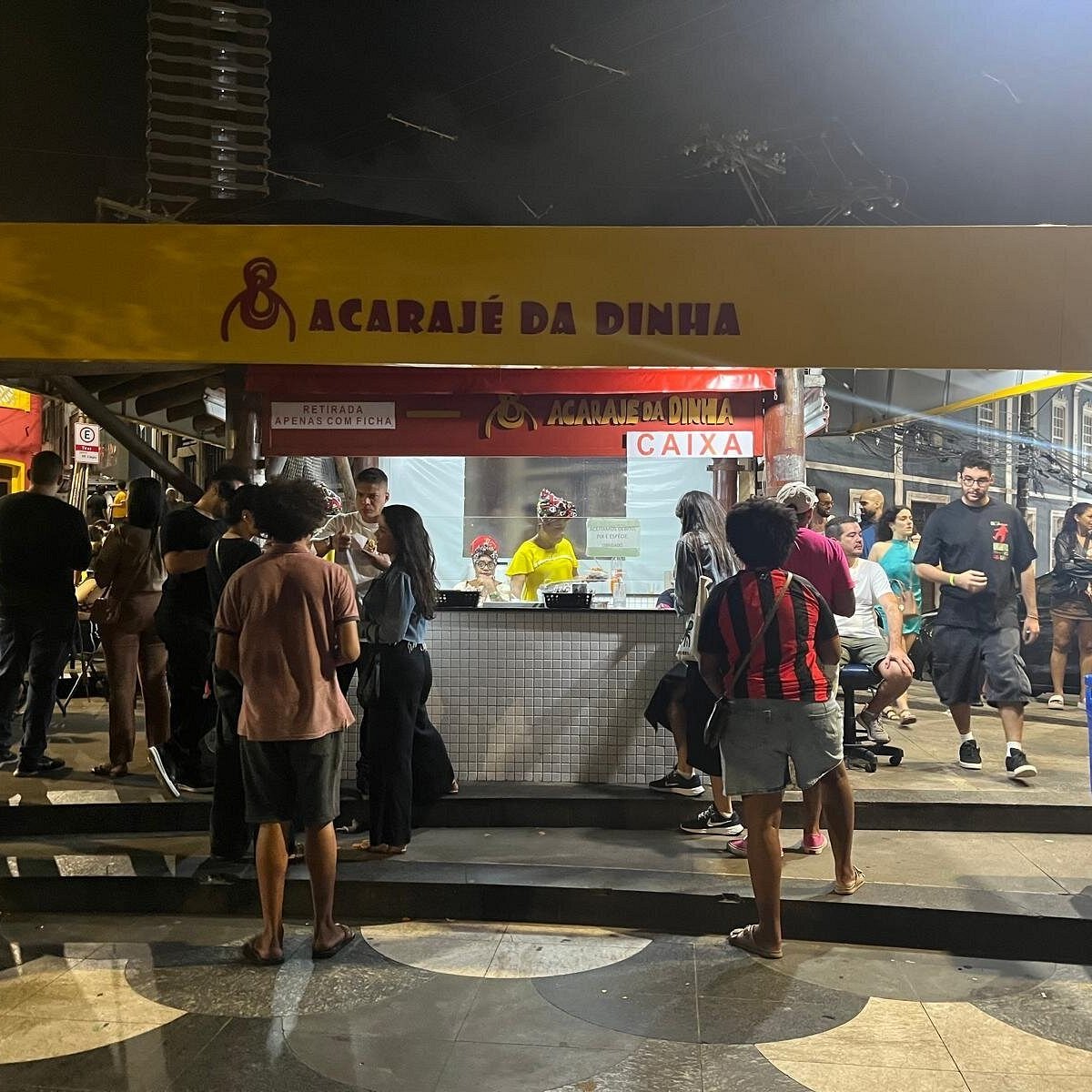
Acarajé da Dinha at Largo de Santana in Rio Vermelho is the most-referenced acarajé stop in Salvador — and for good reason. At street-food prices, the quality-to-cost ratio is hard to beat anywhere in the city. Walk up, arrive early to avoid the longest queues, and eat standing in the square.
About Acarajé da Dinha
The Verdict
Acarajé da Dinha at Largo de Santana in Rio Vermelho is one of those street-food stops where the scarcity is real: the queue forms before she sets up, and on weekends in Salvador's summer season it moves slowly. If you are in Bahia and have not eaten acarajé from this spot, you are skipping the most-referenced version of the dish in the city. Go once. Go early.
What You're Getting
Acarajé is a deep-fried black-eyed pea fritter, split open and filled with vatapá (a spiced shrimp and bread paste), caruru (okra-based), dried shrimp, and a salsa. The aroma when the fritters hit hot palm oil is immediate and distinctive — dense, nutty, faintly smoky — and it carries across the Largo. This is the sensory anchor of the experience. There is no kitchen to enter; the production happens in open air on a traditional clay pot setup, which is part of what draws crowds in the current season when Rio Vermelho's square fills with early-evening foot traffic. The format is informal: you order, you wait, you eat standing or perched nearby. No table service, no reservations, no dress expectation.
On the value question, acarajé at this price tier sits at the accessible end of Salvador eating, you are spending street-food money for what is widely considered the city's benchmark preparation. That ratio is hard to argue. Compare it to sitting down at a formal Bahian restaurant in Pelourinho where you will pay multiples more for similar base ingredients presented with less immediacy and often less skill in the frying. For a value-seeker, Dinha's is the clear answer in this category.
The crowd skews local on weekday afternoons, tourist-heavy on weekend evenings, and the line is longest when cruise ships are in port. If you are visiting during Salvador's high season (December through Carnival), arrive before 5 PM. The Largo de Santana location in Rio Vermelho also puts you close to Bistrô Brazfood Drink Bar and Purgatório, so you can pair an evening here with a drink nearby without doubling back across the city.
For more on eating and drinking in the city, see our full Salvador restaurants guide, our full Salvador bars guide, and our full Salvador experiences guide. If you are planning a longer stay, our full Salvador hotels guide and our full Salvador wineries guide are also worth a look.
Practical Details
Reservations: None, walk-up only. Dress: Casual street wear. Budget: Street-food pricing; expect to spend a small amount per person. Location: Largo de Santana, Rio Vermelho, Salvador. Booking difficulty: Easy, no advance planning required, though timing your arrival off-peak saves waiting. Leading time to go: Weekday afternoons in the current season for shorter queues.
Considering other cities in Brazil? See Tan Tan in São Paulo, Bar de Copa in Rio de Janeiro, Bar da Lora in Belo Horizonte, and Dionisia Restaurante VinhoBar in Porto Alegre. Or venture further to Bar Leather Apron in Honolulu for a very different bar experience.
Planning details
- Location
- Largo de Santana - Rio Vermelho, Salvador - BA, 41950-650, Brazil
- Website
- toemluna.gesfood.com.br/autoatendimento
- Phone
- +55 71 99189 2998
The take
The Take
The Vibe
Acarajé da Dinha presents a street-food scene steeped in history and ritual. The stall sits in Largo de Santana within Rio Vermelho, where baianas in traditional white dress fry acarajé on cast-iron pans in dendê oil. The write-up frames the practice as a living cultural heritage—formally registered by IPHAN—and emphasizes the continuity of West African culinary techniques in today's city. The experience feels classic and human-scaled: quick, public, and anchored to community rhythms rather than formal dining rooms. It reads as a historic, authentic street counter that celebrates technique, taste and local tradition.
Best For
This is a place for spontaneous, informal eating—ideal for people who wander the neighbourhood without a rigid plan. The stall rewards visitors seeking a direct encounter with Salvador's food culture, whether alone or in a small, mobile group. Because the setting is an outdoor barraca with work happening at the counter, it favors quick bites and late-evening or open-street moments rather than long, seated meals. The emphasis is on cultural encounter and tradition: expect an immediate, communal street-food interaction rather than a restaurant-style service.
Ordering Tips
Order specifying the fillings and spice level: acarajé is split and filled at the stand, typically with vatapá, caruru and fresh or dried shrimp. Heat is calibrated to preference—the pimenta da baiada, a fermented pepper sauce, is applied according to how spicy you like it. Everything is assembled quickly at the counter and meant to be eaten standing or while walking; there is no seating infrastructure. Treat the exchange as both a culinary transaction and a cultural moment with the baianas who prepare and sell the fritters.
Venue details
Ambiance
Vibrant and bustling street atmosphere in a lively square surrounded by bars and locals.
Tags
Vibe
Best For
Format
View
Accessibility
Know before you go
Know Before You Go
- Getting there
- Largo de Santana - Rio Vermelho, Salvador - BA, 41950-650, Brazil
Planning details
Location
Largo de Santana - Rio Vermelho, Salvador - BA, 41950-650, Brazil · Directions
Also consider
Also Consider
- Tan Tan, Notable alternative
- Guilhotina, Notable alternative
- Sky Bar - Hotel Unique, Notable alternative
- SubAstor, Notable alternative
- Bar de Copa, Notable alternative
Bar context
Comparing Acarajé da Dinha against Salvador's bar and casual-dining peers is a bit like comparing formats: Dinha's is a street-food stand in an open square, while venues like Tan Tan and Guilhotina operate as full bar experiences with cocktail programs, seating, and atmosphere. If you want a drink with your evening, you need to combine Dinha's with a bar nearby, it does not compete on that axis.
For pure value per outing in Salvador, Dinha's is at the low end of spend with a high ceiling on quality. Sky Bar - Hotel Unique and SubAstor are at the opposite end, polished, priced accordingly, and suited to a different kind of evening. Bar de Copa sits somewhere in between on formality. If your priority is spending as little as possible while eating something that locals actually rate, Dinha's wins that comparison without argument.
Booking difficulty is also a differentiator: Dinha's requires no reservation, no app, and no planning beyond showing up at the right time of day. If you are in Rio Vermelho for an evening, this is the easiest food decision you will make in Salvador. For a full night out, pair it with one of the bars listed above, but start here if you have not eaten acarajé yet.
Explore Salvador
Around this place
Discover more on Pearl
Unlock the full Acarajé da Dinha guide in Pearl, including awards, comparisons, FAQs, planning details, and nearby places.
Compare Acarajé da Dinha
| Venue | Awards |
|---|---|
| Acarajé da Dinha | No published awards |
| Tan Tan | No published awards |
| Guilhotina | 2019 World's 50 Best Bars · #15 |
| Sky Bar - Hotel Unique | No published awards |
| SubAstor | Top 500 Bars 2026 · #388Top 500 Bars 2025 · #1882023 World's 50 Best Bars · #58 |
| Bar de Copa | 2010 World's 50 Best Bars · #41 |


How Acarajé da Dinha stacks up against the competition.
FAQ
Frequently Asked Questions
What's the crowd like at Acarajé da Dinha?
Expect a mixed local and tourist crowd, heavy on Salvadorans who treat this as a weekly ritual. The queue at Largo de Santana in Rio Vermelho forms early and moves steadily — this is a standing, street-side experience, not a seated one. Come prepared to wait alongside regulars who know exactly what they're ordering.
What's the signature drink at Acarajé da Dinha?
There is no documented drink offering at Dinha's stall — the focus is squarely on the acarajé and its fillings. For drinks alongside your food, the surrounding bars and kiosks around Largo de Santana in Rio Vermelho cover that gap easily.
Is the food good at Acarajé da Dinha?
Yes, and consistently so. Acarajé here means a deep-fried black-eyed pea fritter filled with vatapá, caruru, and dried shrimp — a combination that defines Bahian street food. Dinha's version is among Salvador's most referenced, which is why the queue is real. If you're eating acarajé in Salvador, this is the stop most people point you toward.
Is Acarajé da Dinha good for a date?
Only if you're both comfortable eating standing on a street corner in Rio Vermelho. There's no seating, no ambiance beyond the Largo de Santana square, and no reservation to make. It works well as a casual, low-cost stop in a bigger evening out in the neighbourhood — not as a standalone dinner date.
Does Acarajé da Dinha have happy hour deals?
No. This is a street-food stall with street-food pricing — the value is already built in. There are no documented promotions or time-based offers. You pay per item at the counter and move on.
Does Acarajé da Dinha have outdoor seating?
No formal seating of any kind. Acarajé da Dinha operates as a walk-up street stall at Largo de Santana in Rio Vermelho. You order, you eat standing or find a nearby spot in the square. That's the format — plan accordingly.
Is Acarajé da Dinha good for groups?
Yes, within reason. Groups of four to six move through fine — order individually at the stall and eat together in the open square. Larger groups work too, though the queue gets unwieldy if everyone arrives at the same time. This is not a booking scenario; just show up together and manage your own order.