
Bar in Paris, France
Silencio Club
100ptsLynch-Designed Members' Underground
About Silencio Club
Silencio Club at 142 Rue Montmartre occupies a distinct tier in Paris nightlife: a members-inflected venue that operates closer to a cultural institution than a conventional bar or club. The basement spaces, conceived by David Lynch, run programming that crosses film, music, and art, placing it in a peer set defined by format discipline rather than volume or spectacle.
Paris After Midnight, Below Street Level
The approach to Silencio on Rue Montmartre in the 2nd arrondissement gives little away. The address sits on a street that transitions quickly from press-office buildings to late-night commerce, and the entrance itself is deliberately understated — no illuminated signage, no queue infrastructure that announces itself from the corner. That restraint is not incidental. In a Paris nightlife market that has long oscillated between grand-café theatrics and underground anonymity, Silencio was designed from the beginning to occupy a third position: a private-club format that opens selectively to the public after a certain hour, with cultural programming as its central proposition rather than a supporting act.
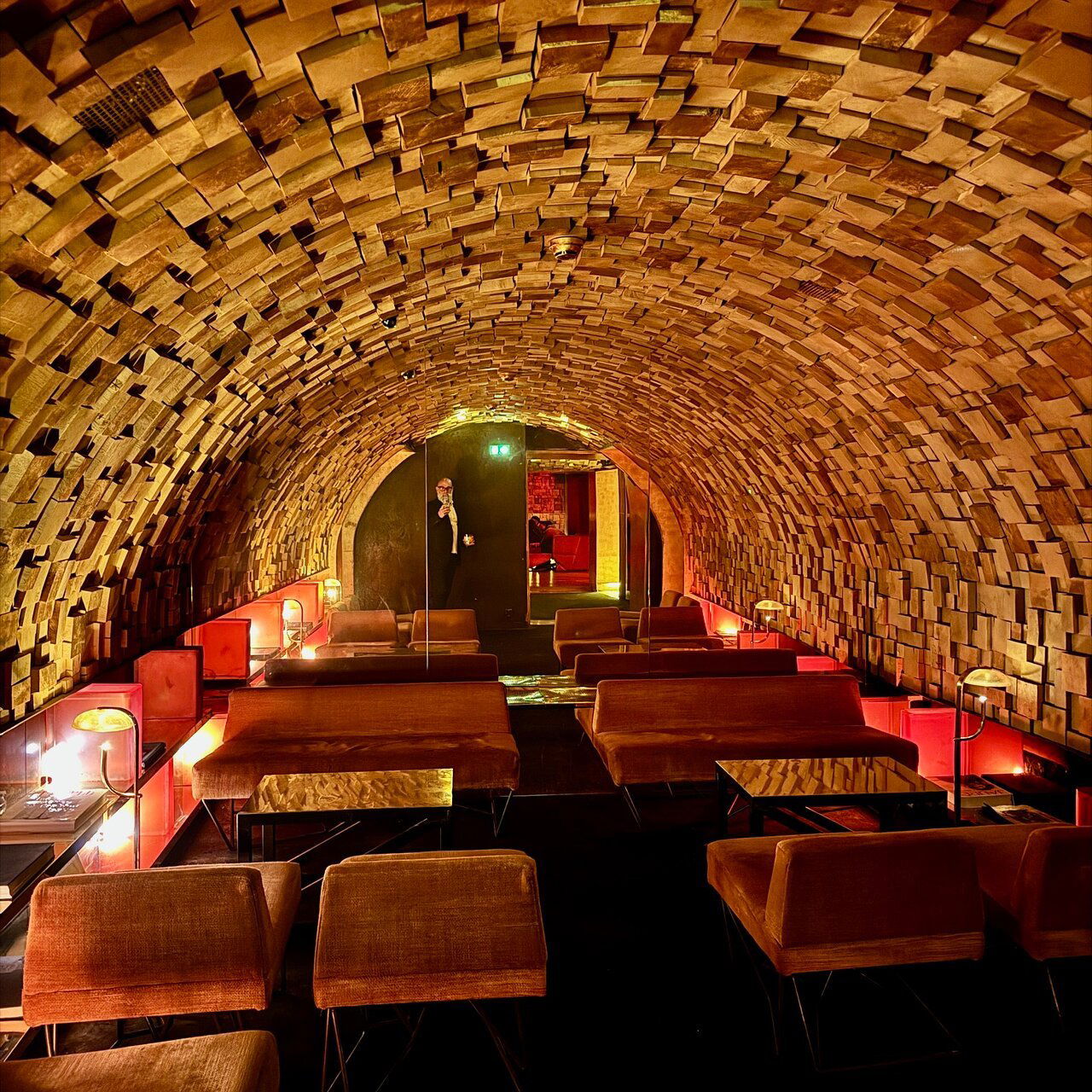
The interiors were conceived by the American filmmaker David Lynch, and they read accordingly. The spaces below street level layer deep reds, velvet textures, and theatrical lighting in ways that reference cinematic surrealism more than conventional hospitality design. Where many Paris bars in this tier reach for minimalism or heritage patina, Silencio's rooms feel composed — as if the visual environment is making an argument rather than providing a backdrop. That is an unusual quality in the city's bar and club inventory, and it places Silencio in a peer set that has more in common with institutional cultural venues than with the cocktail bars of the Marais or the brasserie-adjacent drinking culture of Saint-Germain.
Where It Fits in the Paris Night Scene
Paris's premium bar and late-night offering has stratified considerably over the past decade. At one end sit cocktail-focused addresses like Danico and Candelaria, both of which have built reputations on technical drink programs and relatively accessible booking. At the other end, large-format venues like Buddha Bar compete on spectacle and scale. Silencio sits outside both of those categories. Its membership structure, cultural events calendar, and Lynch-designed environment position it closer to the members-club model that has expanded across London and New York but remains comparatively rare in Paris at this execution level.
The venue's public hours, which typically begin after midnight, function less as a fallback for non-members and more as a deliberate permeability in an otherwise exclusive format. That structure matters because it changes who is in the room: the late-night public admission brings in visitors and curious Parisians alongside the cultural-industry membership base, which creates a social dynamic distinct from either a pure private club or a conventional nightclub. Bar Nouveau operates in the same arrondissement but within a very different register, making the two addresses genuinely complementary rather than competitive for the same evening.
Programming as the Core Offer
In the broader European club-culture context, venues that place programming at the center of their identity tend to generate a different kind of loyalty than those built around drink quality or interior design alone. Silencio's events calendar has historically covered film screenings, live music, DJ sets, and art installations, with the membership community providing a stable audience that gives the programming room to take risks. That model connects Silencio to a lineage of European cultural clubs that treat the nighttime hours as a continuation of artistic life rather than a departure from it.
This is worth noting for visitors planning a Paris itinerary around drinking and nightlife. The venue's appeal is not reducible to its cocktail list or its room design, even though both receive consistent attention. The question of what is happening on a given night is as relevant to the experience as where you are sitting. For visitors who approach Paris nightlife through food-and-drink venues alone, Silencio requires a slight recalibration of expectations , and rewards it accordingly. For context on how Paris's broader hospitality scene is structured, our full Paris restaurants guide covers the city's drinking and dining offer across neighbourhoods and price tiers.
The Sourcing Question in a Different Register
The editorial angle around ingredient sourcing typically applies most directly to restaurant kitchens, but in Silencio's case the relevant question is about what the venue sources and curates at a cultural level: the filmmakers, musicians, and artists whose work populates the programming calendar. Paris has a deep institutional infrastructure for contemporary art and film, and venues that draw from that infrastructure rather than booking generically tend to produce programming with a different texture. Silencio's position on Rue Montmartre, within reasonable distance of both the Grands Boulevards cultural corridor and the 1st arrondissement's museum density, gives it geographic adjacency to the communities it programs for and draws from.
The same logic applies to how Silencio compares with equivalents elsewhere in France. Venues like La Maison M. in Lyon and Coté Vin in Toulouse operate in cities with their own cultural programming scenes, but Paris's concentration of film-industry professionals, gallerists, and music producers gives a venue like Silencio a talent pool that regional cities cannot match at the same density. That sourcing advantage is structural, not circumstantial.
Planning a Visit
Silencio's access model requires clarity before you go. Members and their guests enter throughout the venue's operating hours. Non-members are generally admitted after midnight, subject to the venue's door policy on any given night. The programming calendar is the primary variable: a screening or live event changes the room's energy and capacity dynamics relative to a standard club night. Checking the current events schedule before planning arrival time is practical advice rather than a formality.
For visitors building a Paris evening that moves across registers, the 2nd arrondissement's proximity to the Marais and the northern part of the 1st means Silencio pairs well with an earlier dinner and drinks in adjacent neighbourhoods before a late arrival. Those planning a broader France itinerary that extends beyond Paris will find useful reference points in venues like Papa Doble in Montpellier, Au Brasseur in Strasbourg, Bar Casa Bordeaux in Bordeaux, and Le Café de la Fontaine in La Turbie, each of which reflects the specific character of its city's drinking culture in ways that contrast instructively with the Paris model. For an international comparison point in a different format entirely, Bar Leather Apron in Honolulu represents a technically driven cocktail program that shares Silencio's commitment to format discipline, even if the two venues operate in entirely different registers.
Frequently Asked Questions
What drink is Silencio Club famous for?
Silencio is not primarily known for a signature cocktail in the way that technically focused bars like Danico or Candelaria are. The bar program supports the broader cultural experience rather than leading it. What draws attention is the environment , the Lynch-designed rooms and the programming calendar , with drinks functioning as competent accompaniment to a night that is defined by its atmosphere and events rather than its menu.
What should I know about Silencio Club before I go?
The membership model is the most important structural fact. Non-members are admitted after midnight on most nights, but the door policy is selective and the experience varies significantly depending on what is programmed that evening. Paris visitors should check the events calendar in advance, plan for a late arrival, and understand that Silencio operates closer to a cultural institution than a conventional bar , which is precisely what distinguishes it in the city's late-night offer.
What's the leading way to book Silencio Club?
Members book through the club's membership channels. For non-members, Silencio does not operate a conventional reservation system for general admission , arrival after midnight with the door policy in effect is the standard access route. Checking the club's current event listings before visiting will give the clearest indication of what kind of night to expect and whether the programming aligns with your reasons for going.
What's Silencio Club a strong choice for?
Silencio suits visitors who want Paris nightlife with a cultural dimension rather than a purely social or drink-focused one. The Lynch-designed environment and the events programming make it a specific kind of evening , late, layered, and oriented toward an arts-adjacent crowd. It is a less obvious choice than a cocktail bar or a heritage brasserie, and that is the point.
Is Silencio Club the kind of venue you visit for the space itself, or does the programming matter?
Both elements are load-bearing. The David Lynch-designed interiors give the venue a visual identity that is genuinely unusual in Paris's club inventory, and the rooms are worth experiencing independent of what is on the calendar. But the programming is what determines the energy of any given night , a film screening produces a different room than a DJ set or a live performance. For first-time visitors, arriving on an event night rather than a standard club night will give the more complete picture of what Silencio is built to do.
Related editorial
- Best Fine Dining Restaurants in ParisFrom three-Michelin-star icons to the next generation of Parisian chefs pushing boundaries, these are the restaurants that define fine dining in the world's culinary capital.
- Best Luxury Hotels in RomeFrom rooftop terraces overlooking ancient ruins to Michelin-starred hotel dining, these are the luxury hotels that make Rome unforgettable.
- Best Cocktail Bars in KyotoFrom sleek lounges to hidden speakeasies, Kyoto's cocktail scene blends Japanese precision with global influence in ways you won't find anywhere else.
Save or rate Silencio Club on Pearl
Keep this venue in your Pearl passport, rate it after you visit, and track it alongside every other place you collect.