
Bar in Paris, France
La Buvette
100ptsProducer-Focused Pour
About La Buvette
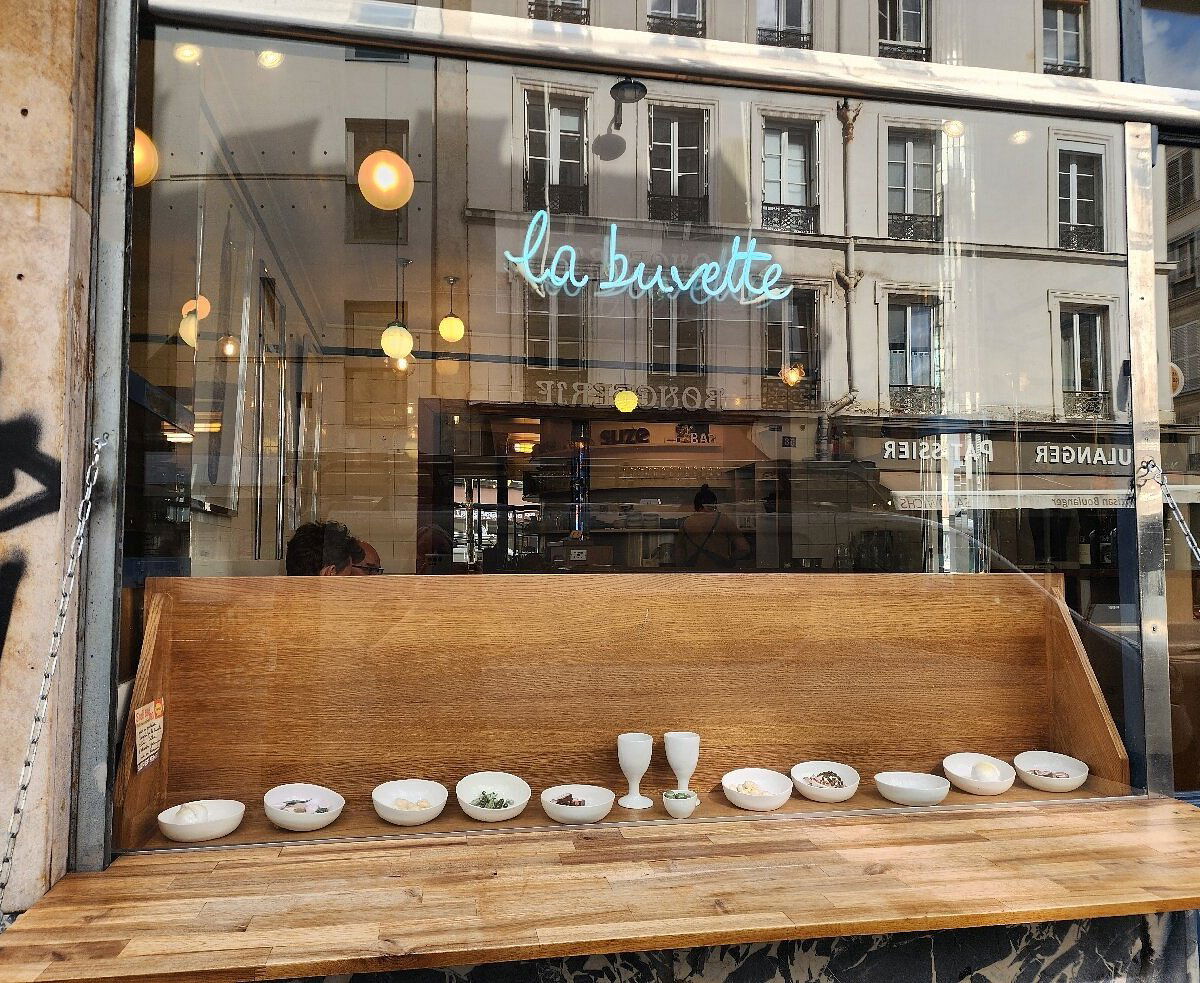
On Rue Saint-Maur in the 11th arrondissement, La Buvette occupies the quieter, more instinctive end of Paris natural wine culture: small plates, bottles chosen with conviction, and a format that rewards those who arrive without a fixed agenda. The room is compact, the offering edited, and the logic is that of a well-stocked cave rather than a restaurant with ambitions to be anything other than what it is.
Where the 11th Arrondissement Drinks Seriously
Rue Saint-Maur runs through one of Paris's densest concentrations of neighbourhood bars and wine caves, and it is along this stretch that La Buvette has become a reference point for a particular kind of Parisian drinking. The room is small, the shelves are stacked, and the atmosphere belongs to no particular era of bar design — it operates somewhere between a traditional cave à manger and a contemporary natural wine bar, without fully committing to either. That ambiguity is part of its appeal. In a city that has spent the past decade arguing about what a wine bar should be, La Buvette has largely ignored the debate and simply done the thing.
The Back Bar as Editorial Statement
Paris wine bars split broadly into two categories: those that use their bottle list as a price signal, and those that use it as an argument. La Buvette belongs to the second group. The selection gravitates toward natural and low-intervention producers, with a depth of curation that reflects genuine engagement with the grower circuit rather than a surface-level commitment to biodynamic labelling. In practical terms, this means the back bar functions as a running editorial — bottles come and go, producers rotate, and the list at any given visit is unlikely to match what was there six months prior.
This model of curation has become increasingly common in Paris's eastern arrondissements, where a cluster of bars and caves around Oberkampf, Parmentier, and Saint-Maur operate on similar principles: small producers, limited volumes, and a preference for wines that require some explanation. What distinguishes one venue from another in this tier is less the category of wine and more the specificity of the selection and the knowledge available to discuss it. At La Buvette, the format is intimate enough that those conversations happen readily , the space does not permit the kind of anonymity that allows a bad pairing to go unaddressed.
For context on how Paris's cocktail bars approach a comparable depth-of-back-bar philosophy, Danico and Candelaria both operate selective, programme-led formats that reward repeat visits in much the same way. The comparison is instructive: across drink categories, the bars in Paris that generate the most sustained attention are those where the selection feels authored rather than assembled.
Food as Framework, Not Feature
La Buvette pairs its wine with a tight food offering that functions as a support structure rather than a destination in its own right. Charcuterie, cheese, conserves, and a short rotation of small plates sit alongside the bottles , the kind of eating that extends a glass without demanding its own critical evaluation. This is a deliberate format choice. Wine bars that over-invest in food risk shifting the gravitational centre of the room away from the bottles, and in Paris's natural wine circuit, the bottle is almost always the point.
The food format also keeps the operation lean enough to sustain the bottle curation. Venues in this category that expand their kitchen tend to compromise on wine selection as logistics scale up. La Buvette's restraint on the food side is, in this sense, a structural decision that protects the integrity of what ends up on the table to drink.
The 11th and Its Drinking Culture
The 11th arrondissement's bar culture has evolved significantly since the early 2010s, when the neighbourhood first began attracting a concentration of serious independent operators. The initial wave was dominated by cocktail bars and bistrots; the subsequent phase brought a generation of natural wine-focused venues that treated the cave à manger format as a platform for genuine producer advocacy. La Buvette sits inside that second wave, at an address , 67 Rue Saint-Maur , that places it within walking distance of several bars and restaurants operating in a comparable register.
For those cross-referencing Paris's broader drinking scene, Bar Nouveau and Buddha Bar represent different points on the city's bar spectrum , the former leaning into technical programme design, the latter toward high-production atmosphere. La Buvette occupies neither of those positions. It is, by contrast, a neighbourhood bar that happens to stock unusually well-considered wine.
Beyond Paris, the model it represents , small room, rotating selection, producer-direct relationships , appears in various French cities with local inflections. La Maison M. in Lyon and Coté vin in Toulouse share broadly similar DNA, while Bar Casa Bordeaux applies a comparable approach in a city whose wine identity is considerably more institutionalised. Further afield, Papa Doble in Montpellier and Au Brasseur in Strasbourg show how the independent bar format adapts across France's regional drinking cultures. Even internationally, the ethos surfaces in venues like Bar Leather Apron in Honolulu and Le Café de la Fontaine in La Turbie, both of which demonstrate that serious curation at intimate scale is a discipline, not a format tied to any single geography.
Visiting La Buvette: What to Know
La Buvette operates in a format that rewards unhurried visits. The room is small, turnover is not particularly managed, and the experience of working through bottles with knowledgeable guidance takes time. Arriving with a specific bottle in mind is less useful than arriving open to what is currently available , the rotating selection means that the most interesting options at any given visit are determined by what has recently come in rather than by a fixed list.
Reservations, where possible, are advisable, particularly on weekday evenings when the neighbourhood's working population converges on a limited number of serious venues. Walk-ins are possible but not guaranteed, and the compressed format of the room means that capacity fills quickly. For the full picture of where La Buvette sits within Paris's bar and restaurant scene, the EP Club Paris guide maps the city's current operators across categories and price points.
Know Before You Go
- Address: 67 Rue Saint-Maur, 75011 Paris, France
- Neighbourhood: 11th arrondissement, near Parmentier and Oberkampf
- Format: Small natural wine bar and cave à manger with rotating bottle selection
- Walk-ins: Possible, but the compact room fills quickly on weekday evenings
- What to order: Follow the staff recommendation on the current rotation rather than requesting a specific bottle
- Metro: Parmentier (line 3) or Oberkampf (lines 5 and 9)
Frequently Asked Questions
What do regulars order at La Buvette?
Regulars tend to defer to whatever is rotating through the current natural wine selection rather than anchoring to a fixed order. The food , charcuterie, cheese, conserves , is ordered alongside bottles as an extended drinking framework. The venue's recognition in Paris's natural wine circuit comes specifically from the quality of that bottle curation, so following the current recommendation is the more reliable approach than arriving with a fixed request.
Why do people go to La Buvette?
La Buvette draws a crowd that is specifically seeking serious, producer-focused natural wine in a format that does not require a restaurant budget. In a city where wine bars range from tourist-facing to deeply specialist, it sits toward the specialist end: the selection is rotated, the producers are often small-volume, and the experience rewards prior knowledge of the category without demanding it. Its location in the 11th arrondissement places it in an area with a concentration of comparable independent operators, making it part of a broader neighbourhood drinking circuit rather than a standalone destination.
Do they take walk-ins at La Buvette?
Walk-ins are possible at La Buvette, but the room's limited size means availability is not reliable, particularly on weekday evenings when the 11th's bar density works against casual browsing. If La Buvette is a priority rather than a fallback, arriving early or, where possible, reserving in advance is the more dependable approach. Contact details are not currently listed through EP Club's database, so checking directly or via a Paris concierge service is advisable.
What kind of traveller is La Buvette a good fit for?
La Buvette suits travellers who are already oriented toward natural and low-intervention wine and want to cross-reference what they know against a Parisian neighbourhood venue that takes producer selection seriously. It is not a spectacle bar and does not function as a destination for casual visitors looking for a representative Paris experience. The format, the neighbourhood, and the selection are all calibrated toward people who find the bottle list more interesting than the room's social dynamics.
Is La Buvette known for any particular wine region or producer style?
La Buvette's selection is not anchored to a single French region but gravitates consistently toward natural and low-intervention producers across multiple appellations. This places it within a well-documented strand of Parisian cave à manger culture that emerged strongly in the 2010s, where the back bar functions as a grower advocate rather than a regional specialist. The selection rotates, so a visit in autumn is likely to surface different producers than one in spring , the rhythm of the grower circuit, rather than a static regional focus, drives what appears on the shelves.
Related editorial
- Best Fine Dining Restaurants in ParisFrom three-Michelin-star icons to the next generation of Parisian chefs pushing boundaries, these are the restaurants that define fine dining in the world's culinary capital.
- Best Luxury Hotels in RomeFrom rooftop terraces overlooking ancient ruins to Michelin-starred hotel dining, these are the luxury hotels that make Rome unforgettable.
- Best Cocktail Bars in KyotoFrom sleek lounges to hidden speakeasies, Kyoto's cocktail scene blends Japanese precision with global influence in ways you won't find anywhere else.
Save or rate La Buvette on Pearl
Keep this venue in your Pearl passport, rate it after you visit, and track it alongside every other place you collect.