
Bar in Barcelona, Spain
Tickets
100ptsModernist Tapas Format
About Tickets
On Avinguda del Paral·lel in Barcelona's Eixample, Tickets is the Adrià family's most accessible expression of avant-garde Spanish cuisine — a tapas-format counter where theatrical small plates meet a carnival-inflected interior. Daytime and evening services draw different crowds and carry different rhythms, making the choice of when you visit nearly as consequential as whether you do.
The Room Before the Food
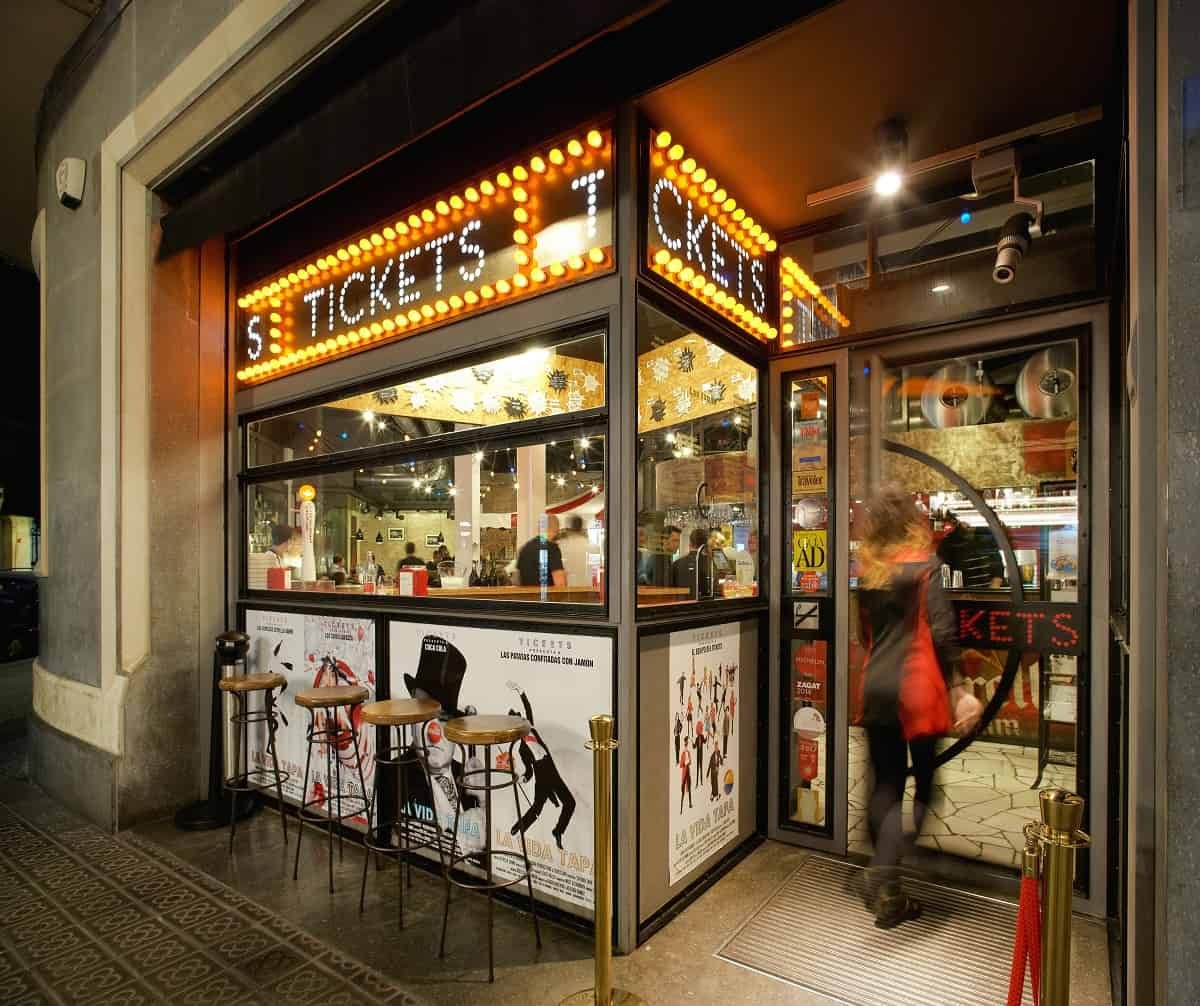
Avinguda del Paral·lel has historically been Barcelona's theatre district, a long arterial street once lined with variety halls and music venues. That context is not accidental. Tickets occupies a space that reads more like a stage set than a dining room: neon signage, circus references, and a deliberate theatricality that signals, from the moment you arrive, that the format here is not about quiet refinement. It is about spectacle contained within precise technique — a distinction that separates Barcelona's avant-garde tapas scene from the more composed, table-service fine dining that dominates in Madrid or San Sebastián.
The broader city context matters here. Barcelona's tapas culture operates differently from Andalusia's or Madrid's. In a city where bar-format dining has historically meant pintxos counters and vermouth bars (for those, Boadas and Dry Martini represent two very different expressions of that inheritance), Tickets positions itself as the point where Spanish culinary modernism meets casual service format. You eat small plates, but what arrives on the plate is anything but casual. That tension between form and content is, arguably, what the restaurant's reputation is built on.
Lunch vs. Dinner: Two Different Restaurants in the Same Room
The lunch-versus-dinner divide at a venue like Tickets is worth understanding before you book, because the two services create genuinely different experiences in mood, pacing, and social composition.
At lunch, the room carries more natural light and a looser energy. Locals on a midweek break, design and creative industry figures from nearby Eixample offices, and informed tourists who planned months in advance tend to populate the earlier service. The pace is slightly faster, the ambient noise lower, and the overall experience feels more accessible — less of an occasion, more of a serious meal. For visitors who want to engage closely with the food and the craft behind it, lunch offers fewer distractions.
Evening service tilts the atmosphere toward celebration. The theatrical lighting design activates fully after dark, and the crowd skews toward groups marking occasions, international visitors who have specifically itinerary-built around the reservation, and a higher ambient volume that makes it feel more like entertainment than pure dining. Neither is the wrong choice, but they are different products. If your priority is the food, lunch deserves serious consideration over dinner , a choice that also tends to sit more comfortably in the broader structure of a Barcelona day, where evening meals rarely begin before nine and can extend well past midnight.
That lunch-forward logic applies across Barcelona's top tier. Spain's daytime dining culture, supported by longer afternoon services and an ingrained belief that lunch is the serious meal of the day, means that the leading seats at many of the city's most-discussed restaurants are not always at dinner. It is a rhythm that visitors from northern Europe or North America often underestimate, and Tickets is a good venue through which to learn it.
Where Tickets Sits in Barcelona's Dining Tier
Barcelona's avant-garde dining scene remains one of the most-discussed in Europe, even as the city's restaurant economy has diversified considerably since the early 2000s. The Adrià family's influence on that scene is documented and verifiable , elBulli's closure in 2011 redistributed creative talent and culinary philosophy across a generation of Barcelona kitchens, and Tickets is the most direct commercial expression of that lineage still operating at scale.
Within the city's current dining map, Tickets occupies a specific position: it is not the most expensive option (that tier belongs to tasting-menu rooms with Michelin credentials and price points in excess of €200 per person), and it is not a neighbourhood bar. It sits in a middle tier that combines accessibility of format (tapas, no forced tasting menu structure) with a level of technique and sourcing that most mid-price restaurants cannot match. That position makes it one of the more interesting propositions in the city, precisely because it refuses easy categorisation.
For a comparison set, the bars and dining rooms that cluster around Eixample and the Raval , including Dr. Stravinsky and Foco , show how Barcelona's food-and-drink scene has evolved away from monolithic fine dining toward format experimentation. Tickets is an earlier and more famous point on that same trajectory. For broader context on how the city's leading venues currently map, our full Barcelona restaurants guide covers the scene in more depth.
Booking and Planning
Tickets operates one of the most-discussed booking systems in Spanish gastronomy. Reservations open on a rolling basis and are taken online; demand at this level means that walk-in availability is effectively zero during high season, and even shoulder months require advance planning. The practical implication is that if Tickets is a fixed point in your Barcelona itinerary, it should be the first thing you book, not the last.
Barcelona's high season runs roughly from April through October, with August bringing the highest tourist concentration and the fullest booking calendars. March and November represent the clearest opportunity for shorter lead times, though even then, a two-to-four week advance window is a minimum assumption. Travellers building itineraries around Spain's bar and dining culture more broadly might also consider how venues in other cities compare: Angelita in Madrid, Bar Sal Gorda in Seville, and Bar Gallardo in Granada each offer a different register of the same national dining culture. For island alternatives, La Margarete in Ciutadella and Garden Bar in Calvia represent Balearic options worth knowing. For something further afield, Bar Leather Apron in Honolulu shows how Spanish-influenced bar culture has travelled.
Know Before You Go
- Address: Avinguda del Paral·lel, 164, Eixample, 08015 Barcelona, Spain
- Neighbourhood: Eixample, near the Paral·lel theatre district
- Booking: Online reservations; opens on a rolling window , book as far ahead as possible
- Leading time to visit: Lunch service for a calmer, food-focused experience; March or November for easier availability
- Format: Tapas-style small plates; no mandatory tasting menu structure
- Dress code: No formal requirement; smart-casual is the norm for evening service
Frequently Asked Questions
What do regulars order at Tickets?
Because the menu at Tickets is built around small plates with seasonal rotation, there is no single fixed dish that defines a visit across all periods. Regulars tend to structure their order around the venue's technically-driven interpretations of Spanish classics rather than a single signature item , the value of the experience lies in the sequence and the craft applied across multiple plates rather than in one standout course. For the most current menu composition, checking the venue's official channels close to your visit date gives the clearest picture.
What is the standout thing about Tickets?
In a city with a strong claim to being the centre of Spanish culinary modernism, Tickets occupies a specific position: it applies avant-garde technique at a tapas price point and within an informal service format. That combination is unusual at this level of execution anywhere in Spain, and it is what separates Tickets from Barcelona's tasting-menu-only fine dining rooms on one side and its neighbourhood tapas bars on the other. The Adrià family's verifiable influence on contemporary Spanish cuisine gives the venue a documented lineage that most comparable restaurants cannot match.
How far ahead should I plan for Tickets?
If you are visiting Barcelona between April and October, treat Tickets as a reservation that needs to be made before you book flights. During peak season, the booking window fills quickly after it opens, and same-week availability is rarely realistic. Outside high season, a two-to-four week lead time is a reasonable minimum assumption, though shorter windows occasionally open due to cancellations. The venue does not take phone reservations; bookings are handled online through its official system.
When does Tickets make the most sense to choose?
Tickets makes most sense for visitors who want serious technical cooking in an informal, high-energy format without the commitment of a fixed tasting menu. It suits lunch if your priority is the food and conversation; it suits dinner if the occasion calls for atmosphere and energy. It is less well-suited to those who prefer quiet, service-heavy fine dining , the room is intentionally loud and communal, which is a feature of the format rather than a shortcoming.
Is Tickets worth the planning effort?
Given the documented lineage and the format's relative accessibility compared to full tasting-menu rooms at the same level of culinary ambition, yes , provided you approach it on its own terms. Tickets is not trying to be a white-tablecloth restaurant, and judging it against that standard would be a category error. Within its own format, it delivers a level of technique and sourcing that is difficult to replicate at a comparable price point in Barcelona's current dining market.
Does Tickets suit first-time visitors to Barcelona, or is it better for those who already know the city's dining scene?
Tickets works well as a first-serious-meal introduction to Barcelona's avant-garde food culture precisely because the tapas format allows for broad exploration without the commitment of a long tasting menu. However, visitors who already have some familiarity with the Adrià family's broader project and Spain's culinary modernism will extract more from the experience , the references and techniques land differently when you have context. Either way, booking well in advance remains the non-negotiable step; the city's dining scene rewards preparation.
Related editorial
- Best Fine Dining Restaurants in ParisFrom three-Michelin-star icons to the next generation of Parisian chefs pushing boundaries, these are the restaurants that define fine dining in the world's culinary capital.
- Best Luxury Hotels in RomeFrom rooftop terraces overlooking ancient ruins to Michelin-starred hotel dining, these are the luxury hotels that make Rome unforgettable.
- Best Cocktail Bars in KyotoFrom sleek lounges to hidden speakeasies, Kyoto's cocktail scene blends Japanese precision with global influence in ways you won't find anywhere else.
Save or rate Tickets on Pearl
Keep this venue in your Pearl passport, rate it after you visit, and track it alongside every other place you collect.